
Edge Cities, 2.0
A framework for finding tomorrow's winning districts

This book has been on my shelf for years. Given my interests, I knew I should read it, but it was written in 1991, and felt too new to be a classic, but too old to be really relevant. I packed it on a trip to the DR last month and loved it.
In the following I will analyze the thesis and history of “Edge Cities” and try to predict which “edges” will be successful in the future.
In 1991, Joel Garreau published Edge City: Life on the New Frontier, documenting a revolution in American urbanism. He’d discovered a pattern: massive office and retail centers sprouting in former farmland and suburbs, places that had been rural in 1960 but now housed more office space than downtown. He called them “edge cities.”
Garreau’s timing was perfect. He captured the exodus from downtowns at its peak. Companies like GE, IBM, and McDonald’s were building campuses in places like Stamford, Connecticut and Oak Brook, Illinois.
The pattern seemed irreversible. American urbanism had evolved through stages: Downtown → Suburbs → Malls → Edge Cities. Each wave had responded to the previous problems. Downtowns were too expensive and congested, so people moved to suburbs. Suburbs lacked commerce, so developers built malls. Malls weren’t workplaces, so corporations built edge cities.
After Garreau’s book, something different happened. Around 1995, young professionals started moving back to cities. Urban cores that had been left for dead—Boston, San Francisco, Washington DC—roared back to life. Garreau’s edge cities? Many struggled.

Thirty-five years after Garreau’s book, we can decipher which edge cities won (and why). And most interestingly, we can speculate about what comes next.
Definition: What’s an Edge City?
Garreau established five criteria:
1. Five million square feet of office space. This was critical mass. Smaller than that and you’re just a suburban office park. Hit 5 million and you have enough density to create a self-sustaining business ecosystem.
2. More than 600,000 square feet of retail. Edge cities needed shopping, not just offices. Workers had to be able to eat lunch, run errands, live portions of their lives there.
3. More jobs than bedrooms. The workday population had to exceed the nighttime residential population. This distinguished edge cities from bedroom suburbs. People commuted to edge cities, not just from them.
4. Perceived as one place. The edge city had to have a regional identity. People said “I work in Tysons Corner” or “I’m meeting you in Buckhead,” not “I work in the office park off Exit 47.”
5. Rural or residential as recently as 1960. This was the key historical marker. Edge cities were new. They weren’t old downtowns that had grown. They were places that had been farmland a generation ago.
By these criteria, Garreau identified 123 existing edge cities and 77 emerging ones across America in 1991. Think clusters around Washington DC (Tysons Corner, Bethesda, Rockville, Silver Spring, Ballston), thick rings around Chicago (Schaumburg, Oak Brook, Naperville), sprawling networks in LA (Century City, Irvine, Orange County Airport area), and growing concentrations in Dallas, Houston, Atlanta, Phoenix, and the Bay Area. They clustered at freeway intersections around major metros, places where corporate headquarters were fleeing expensive, congested downtowns for cheap suburban land.
Garreau assumed the key anchor was corporate headquarters. Fortune 500 companies building sprawling campuses to escape expensive, congested downtowns. That assumption, it turns out, was Garreau’s biggest miss.
What Hasn’t Changed in 35 Years?
A lot has changed since Garreau’s book but sometimes it’s more instructive easier to start with what hasn’t changed and thus might be timeless.
People optimize for commute time, not distance.
Scholars have long demonstrated that for thousands of years, no matter what the transportation technology, the maximum desirable commute has been forty-five minutes [Marchetti’s Constant] …This is why the goal of Edge City today is finding the magic combination of home and work that is at most a forty-five minute trip for each person in the family.
Thirty-five years later, this hasn’t budged. Remote work shifted where people live, but those who commute still mentally budget the same time. Edge cities that kept commutes under 25 minutes typically thrived; those that became parking lots at rush hour died.
NIMBYism is eternal.
Developers love to blame this condition on “no growthers” – people devoted to their country homes who value the landscape as it exists. And, indeed, the people of New England have been marvelously inventive in finding means to slow growth…These limits to growth were not an aberration of the Boston area. They were common in New York, San Francisco, Los Angeles and Washington.
Communities still fight density, still protect single-family zoning, still make building anything nearly impossible.
People want “nice,” and technology can’t fake it.
Little else is more important than Nice. Nice is more important than money. Some people think that Edge Cities rise primarily in locations that are cheap. Wrong. Cost is only one factor… What is included in Nice? Schools with astonishingly high SAT scores. Cultural events…Country Clubs. Athletic clubs. Waterfronts. Scenic vistas. Large lots. Abundant parks.
Every generation thinks new technology will make physical place irrelevant. The telegraph, the telephone, the internet, Zoom—each was supposed to render geography obsolete. Each time, people discovered that screens can’t replace being somewhere that feels good. The edge cities that invested in trees, walkability, and public space won. The ones that stayed purely transactional—office parks and strip malls—lost.
Trust still requires face-to-face.
Humans still put an overwhelming premium on face-to-face contact. Telephones, fax machines, electronic mail, and video conferencing share a problem: they do not produce intense human relationships. They do not create interactions that end with either a fistfight or an embrace. “Trust” is tough to build over a wire... The final value of Edge Cities is – social.
The pandemic proved this. Remote work works for execution, but relationships, mentorship, dealmaking, and culture-building still happen in person. Edge cities anchored by institutions that require physical presence—hospitals, universities, labs—survived. Those anchored by desk jobs are collapsing.
What did Garreau Get Wrong? The Power of Institutions
Garreau’s book was fundamentally about corporate-led edge cities. His paradigmatic examples—Southfield with its Fortune 500 headquarters, Oak Brook anchored by McDonald’s, Schaumburg built around Motorola—all shared the same DNA: they were places where major corporations had fled expensive downtowns for cheap suburban land.
He saw this as the future. Corporations were done with cities, and they wanted space for parking, room for sprawling campuses, and proximity to executives’ homes in affluent suburbs. Edge cities gave them all three. Garreau assumed these corporate anchors were permanent fixtures, the gravitational centers that would hold edge cities together for generations.
Our analysis of 100 edge cities reveals a pattern Garreau missed entirely: institutional edge cities dramatically outperformed corporate ones.
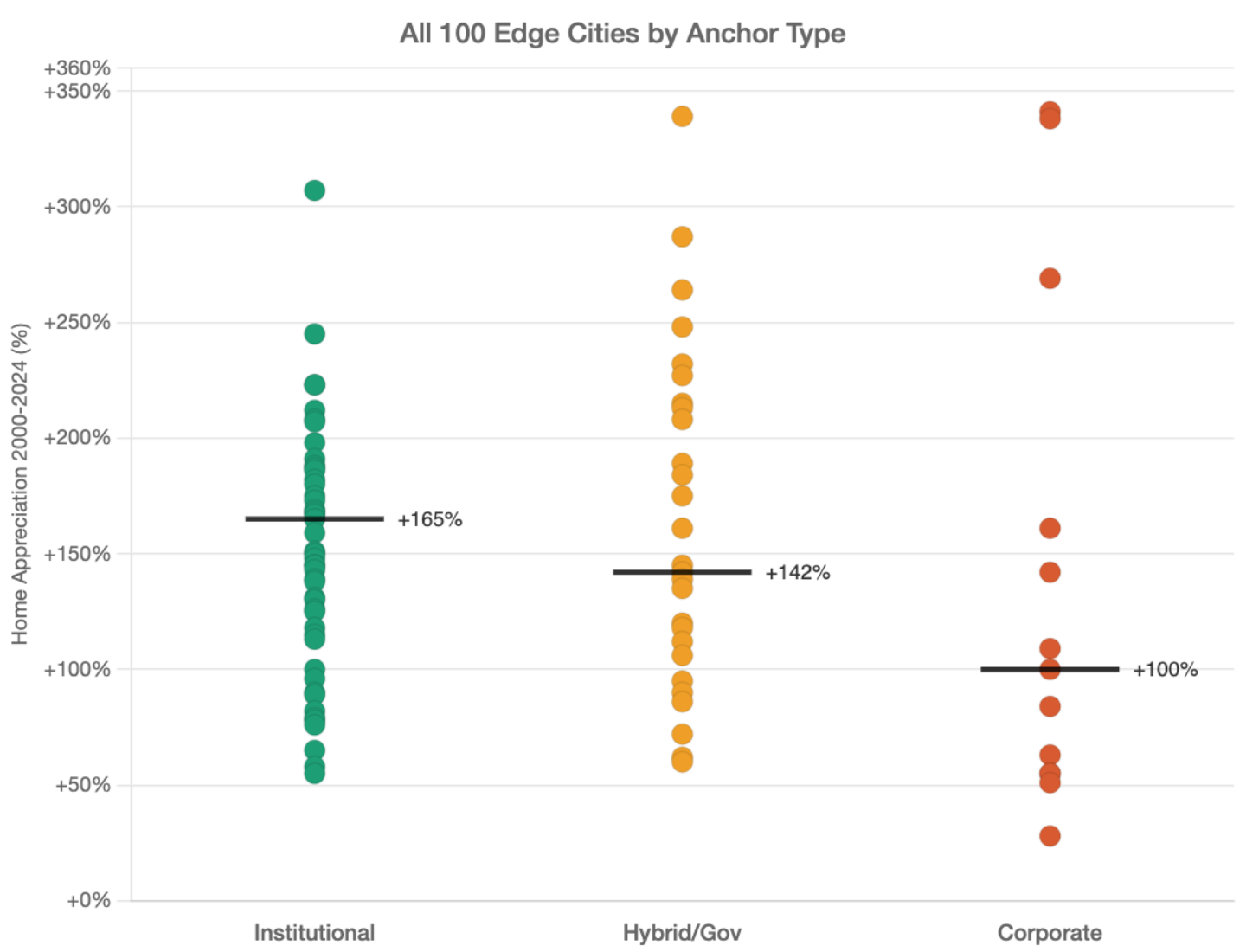
Corporations are mobile, but Institutions aren’t.
When McDonald’s subsequently consolidated operations, it moved its headquarters from Oak Brook to Chicago. When GE restructured, it left Fairfield, Connecticut. When companies went remote during COVID, corporate edge cities hemorrhaged tenants.
Meanwhile, edge cities anchored by institutions weathered every cycle. Cambridge—built around MIT and Harvard Medical—saw home values rise 198% from 2000 to 2024, even as the lab market softened in recent years. Pittsburgh’s Oakland neighborhood, anchored by Carnegie Mellon and UPMC, is up 223%. Princeton, Rockville, Palo Alto: all institutional, all massively outperformed.
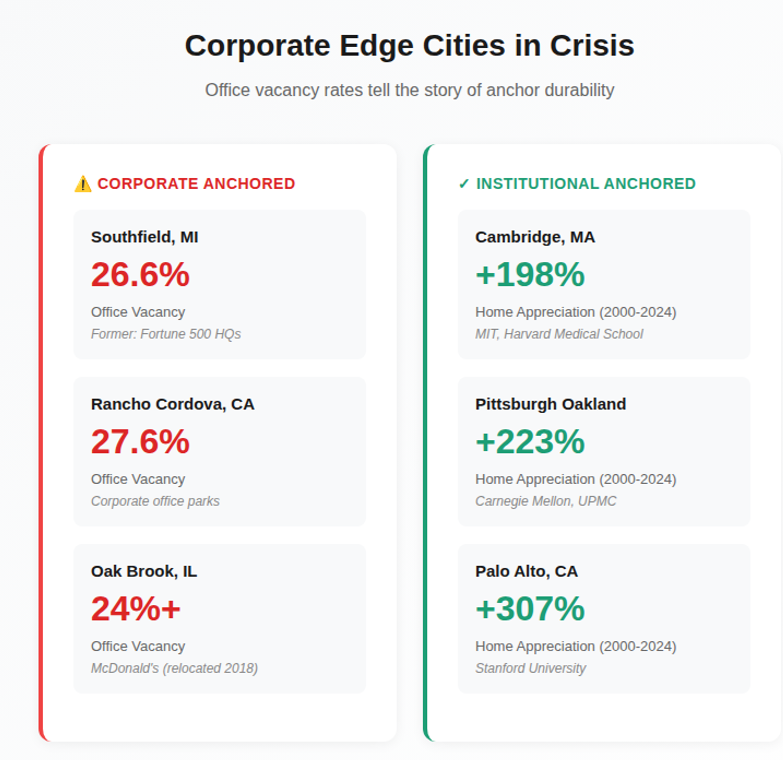
Every one is anchored by an institution that cannot relocate. MIT can’t move its labs. UPMC can’t abandon its hospital network. Stanford’s land grant is permanent. These aren’t just good real estate markets—they’re places where the anchor is geologically fixed.
Meanwhile, the corporate anchors left. McDonald’s consolidated to Chicago. GE moved to Boston, then disbanded. Southfield’s office vacancy rate hit 26.6% as of 2024. Oak Brook’s topped 24%. These weren’t bad locations—they were good enough for Fortune 500s to build billion-dollar campuses. But when the corporations left, nothing held the place together.
The Key Anchors
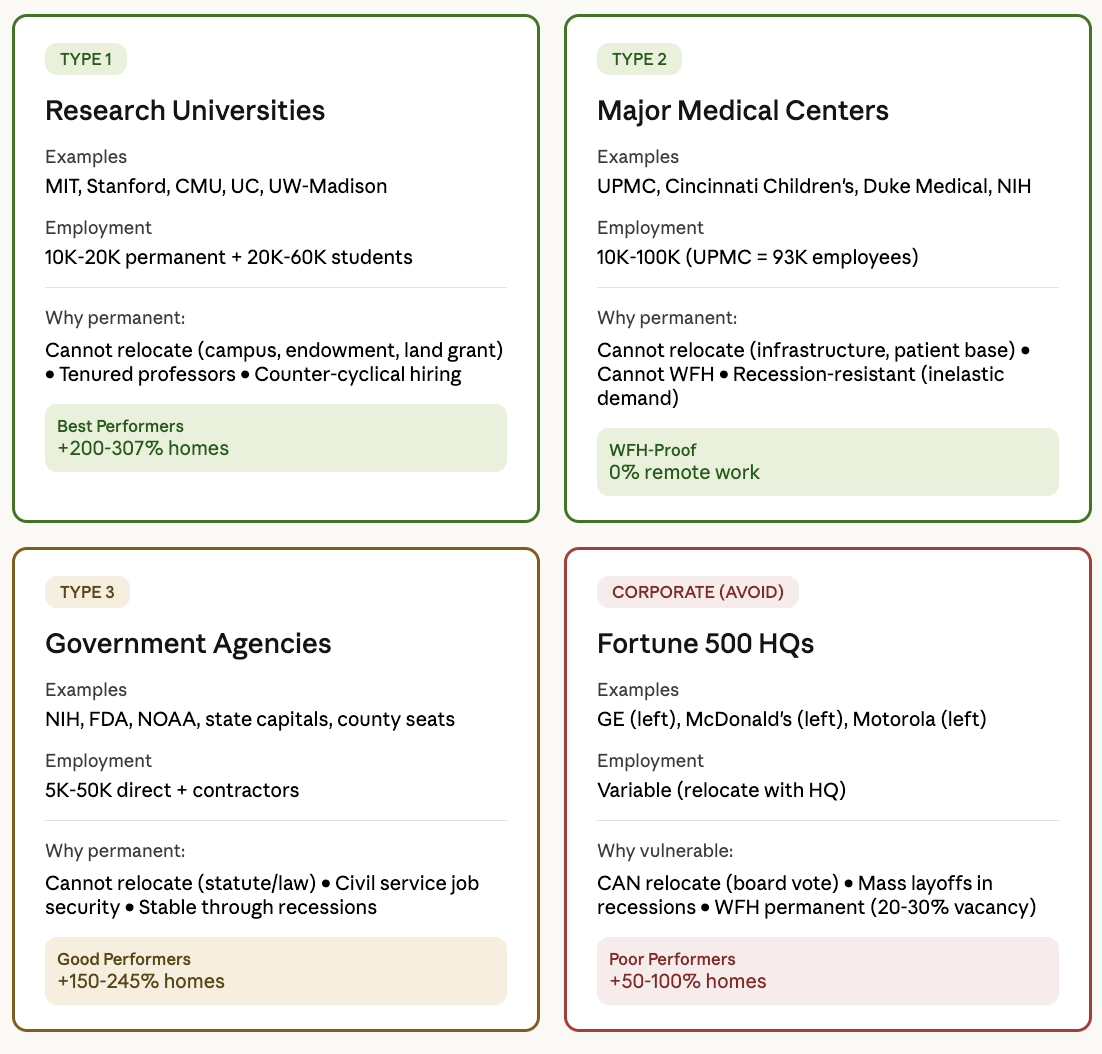
This isn’t about universities being “better” than corporations. It’s about permanence creating durability. Three types of institutions anchor successful edge cities:
Research Universities: They own land (often through state grants or century-old endowments), they can’t relocate labs and specialized facilities, and their reputation is tied to place. Cambridge means MIT. Pittsburgh Oakland means CMU. Palo Alto means Stanford. The geography is the brand.
Academic Medical Centers: You can’t move a Level 1 trauma center. UPMC’s hospital network in Pittsburgh, the Texas Medical Center in Houston, the Mayo Clinic in Rochester—these are billions in fixed assets with patient networks, physician relationships, and regulatory approvals that took decades to build. Remote medicine doesn’t replace surgery.
Government Anchors: State capitals have constitutional permanence. Madison (Wisconsin state capital) and Columbus (Ohio state capital) both score in the top 5 for Edge City 2.0 because legislatures don’t relocate. Federal agencies move rarely and slowly. Even when they do (like the Pentagon’s base realignment process), it’s front-page news because it’s so unusual.
The pattern holds internationally, too. Oxford and Cambridge in the UK, Heidelberg in Germany, Leuven in Belgium—university towns have outperformed corporate clusters for centuries. The difference is that Garreau, writing at the peak of corporate America’s power in 1991, assumed Fortune 500 headquarters were permanent. They weren’t. They never were.
What’s changed isn’t that institutions became more important. It’s that corporate loyalty to place evaporated. In 1991, a company might stay in its headquarters city for 50+ years. By 2020, headquarters relocations had become routine optimization decisions. Tax incentives, executive preference, talent arbitrage—companies moved for 5% cost savings. Universities don’t have that option. Their assets, their alumni networks, their brands are place-specific. They’re stuck. In real estate, that’s a feature, not a bug.
Edge City 2.0: What Comes Next?
If Garreau’s edge cities were defined by the corporate campus exodus of the 1980s, what defines the next wave of urban development in America?
The constants haven’t changed. People still want the same 30-minute commute—they’ve just negotiated to do it three days a week instead of five. NIMBYism remains eternal; if anything, it’s gotten worse. People still want “nice”—good schools, low crime, nature nearby. And despite Zoom fatigue and AI assistants, the most important business still gets done face-to-face. Marchetti’s constant endures.
But the variables have shifted dramatically. Work-from-home is no longer an emergency measure—it’s normalized into hybrid work. AI threatens to commoditize knowledge work itself, making location matter more, not less. Autonomous vehicles are coming (eventually), but they’ll unlock sprawl, not density. The climate crisis is here: Phoenix hit 110°F for 54 consecutive days in 2024; Miami’s insurance market is collapsing. And demographics don’t lie: the median knowledge worker can’t afford a median home in most “successful” metros.
This creates an opening. Not for a return to the old downtown-versus-suburb binary, but for something new: institutional urbanization in affordable, second-tier metros.
To identify where this is happening, I built a 100-point scoring system evaluating 150 institutional anchor districts across five criteria:
The Scoring Framework
1. Institutional Anchor (30 points): Is there a dominant institution that physically cannot leave?
2. Walkability (25 points): Can you live near the anchor without a car?
3. Growth Trajectory (20 points): Is the anchor expanding research, enrollment, or funding?
4. Affordability (15 points): Can knowledge workers buy here?
5. Climate Resilience (10 points): Will this be habitable in 2050?
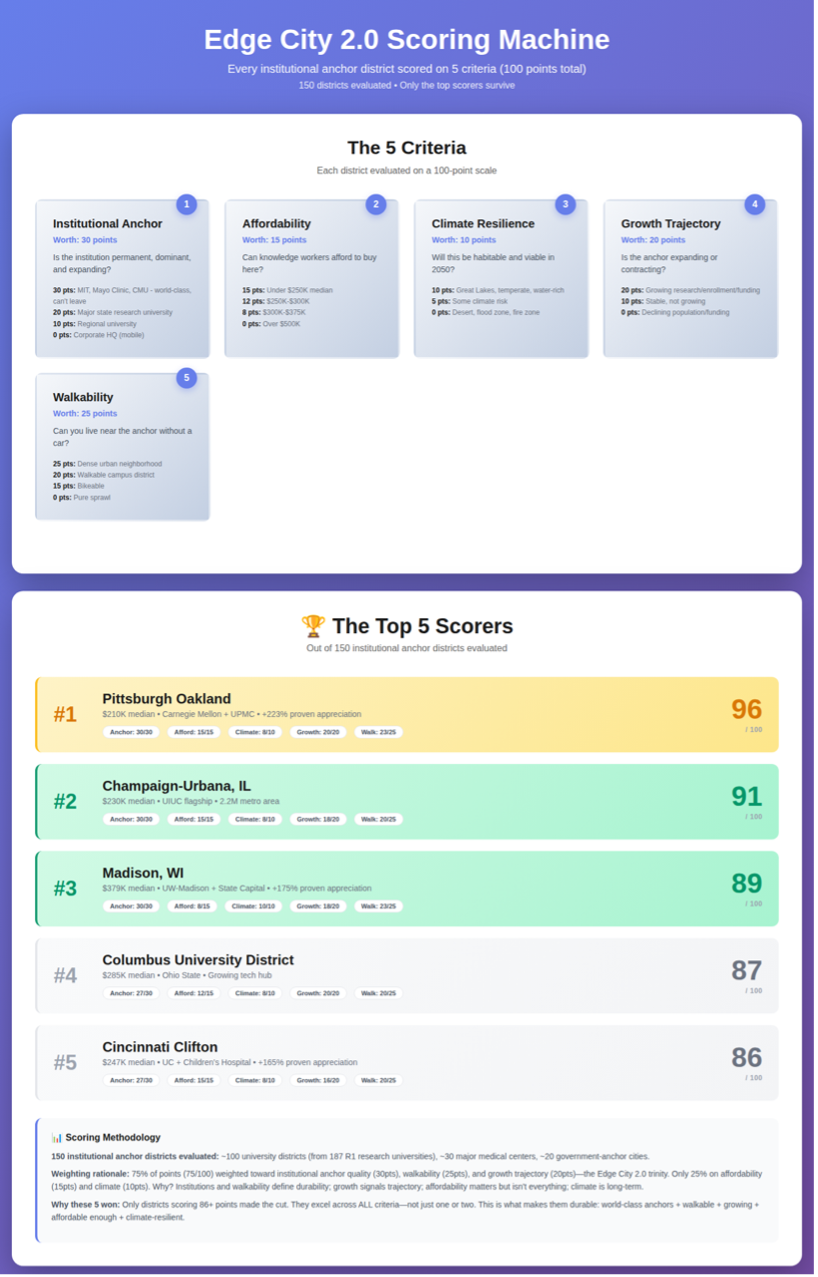
Five districts scored 86 points or higher:
#1 Pittsburgh Oakland (96): The gold standard. Carnegie Mellon and UPMC created an AI/robotics/biotech cluster in a walkable urban neighborhood. Home values up 223% since 2000 but remain affordable. CMU isn’t moving. UPMC isn’t moving. The knowledge workers keep coming.
#2 Champaign-Urbana (91): UIUC’s flagship campus anchors a genuine college town. Median: $230K. Perfect scores on anchor and affordability, strong walkability (20/25). This is what a purpose-built knowledge district looks like when land is cheap and the institution dominates.
#3 Madison (89): The double anchor: UW-Madison plus the state capital. Median: $379K—the least affordable on the list, but still cheaper than Boulder ($578K) or Ann Arbor ($445K). What Madison loses on price, it gains everywhere else: perfect climate resilience (10/10), perfect anchor (30/30), superior walkability (23/25). The isthmus between two lakes creates natural density.
#4 Columbus (University District) (87): Ohio State’s campus district is becoming a tech hub. Median: $285K. Maxed growth score (20/20) as Columbus attracts Intel, Google, and AI startups. The sleeper pick: all the fundamentals of a top-10 metro at half the price.
#5 Cincinnati (Clifton) (86): University of Cincinnati plus Cincinnati Children’s Hospital create a medical/research anchor. Median: $247K. Perfect affordability (15/15), proven appreciation (+165% since 2000). The institutional permanence is obvious: where else are you going to move a children’s hospital?
What this means
It feels like many things are in flux right now, with remote work and AI altering cities and demand patterns. That makes permanence even more scarce and valuable.
Edge 2.0 is not downtown versus suburb, that’s the old fight. This is institutional nodes in second-tier metros offering what expensive “successful” cities can’t: affordability, durability, climate resilience, and quality of life.
The question is whether your anchor can leave. That’s the new “edge”.